Physical AI and AIoT for Port and Terminal Operations
PortOps AI focuses on Physical AI and Artificial Intelligence of Things (AIoT) for port and terminal operations. The approach connects cargo and equipment identification, physical-condition sensing, AI-supported decisions, and authorized operational action. Explore the applications, data requirements, and integration considerations that matter across container handling, terminal equipment, and cargo movement.
Operational Visibility Across The Terminal
PortOps AI examines how Physical AI and AIoT can connect physical observations with the operational records and decisions that support cargo handling. The focus is on defined workflows and measurable evaluation, not on treating every terminal process as a single technology problem.
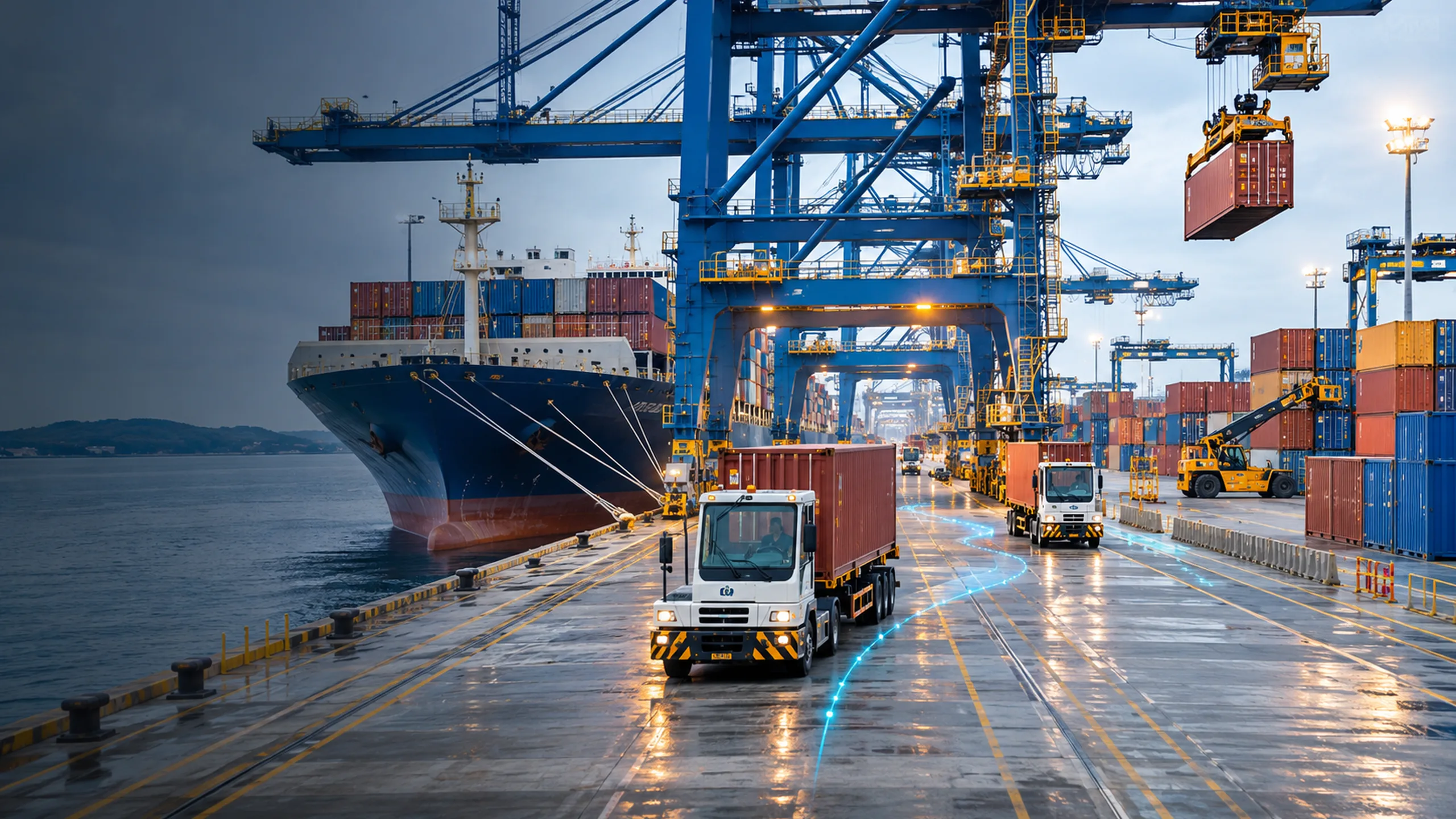
Port and terminal operations depend on coordinated movement between vessel, quay, yard, gate, and onward transport. Container identity, location, custody events, equipment condition, and operating context are often recorded across different devices and business systems. When those records are incomplete, delayed, duplicated, or difficult to reconcile, teams have less reliable information for planning work and resolving exceptions.
Three Operational Priorities
Container Movement and Cargo Traceability
Connect container identity with observed movement and handover events across selected points such as terminal gates, interchange areas, yard blocks, and vessel-loading or discharge workflows. A traceability design must account for missed reads, duplicate events, incorrect associations, delayed messages, and confirmation that a transfer was completed. The relevant measures may include event completeness, false associations, unresolved transfers, reconciliation time, and user effort.
Equipment Condition and Operational Readiness
Bring relevant equipment measurements into operational context by associating readings with asset identity, timestamps, operating modes, and sensor-health information. Depending on the selected equipment and available data, evaluation may consider vibration, temperature, pressure, electrical measurements, visual observations, or other condition indicators. Alerts should support a defined inspection or maintenance response, with detection delay, false-alert rate, missing-data handling, and follow-up verification considered.
Decisions, Coordination, and Authorized Action
Use current observations, asset availability, operating constraints, and business rules to support decisions such as exception review, maintenance prioritization, or resource allocation. Where a workflow includes physical execution, the design must define the target equipment, command interface, authority, operating limits, independent protective functions, and a way to verify the resulting physical state. A recommendation or work-order request is not the same as direct equipment control.
Solution Pathways For Port and Terminal Operations
The right starting point depends on the operational problem, the quality of available data, the systems already in use, and the response a terminal team can realistically take. Explore the following solution areas and define their scope through an application assessment.
Asset and container tracking and traceability
Associate identified containers or other selected assets with movement, location, and handover records. Personnel-location use cases should be purpose-specific and governed by appropriate access and retention controls.
Capability status Proposed solution area; site workflow and technology fit require assessment.
Equipment condition monitoring
Relate sensor readings and operating context to equipment condition, abnormal observations, and reviewed maintenance follow-up.
Capability status Proposed solution area; sensor selection and measurement quality require validation.
Predictive maintenance
Assess whether equipment history, condition data, and maintenance records are sufficient to support failure-risk analysis or maintenance prioritization.
Capability status Further development candidate.
Inspection and quality intelligence
Evaluate selected visual, thermal, or other inspection inputs against defined conditions, acceptance criteria, and human review workflows.
Capability status Further development candidate; field performance requires representative test data.
Operational optimization and physical action
Examine constrained decisions, approval paths, equipment interfaces, and independent confirmation of any physical response.
Capability status Further development candidate; no autonomous-control readiness is implied.
How The Connected Engines Work
PortOps AI’s engine architecture organizes the workflow into four connected functions. The Artificial Intelligence of Things (AIoT) configuration centers on identification, sensing, and AI-supported decisions. The Physical AI configuration adds an action function for workflows where an authorized decision can be connected to equipment or another physical response.
-
IDENTIFY
Associate a container, asset, vehicle, or equipment item with its identifier and relevant event.
-
SENSE
Capture physical measurements or observations with time, operating context, and quality information.
-
DECIDE
Evaluate observations and operational rules to produce an alert, recommendation, or approved action proposal.
-
ACT
Where enabled and authorized, send a bounded command and verify the resulting physical state.
The Identification Engine and Sensing Engine establish what is being observed and what condition is measured. The AI Decision Engine interprets that information within its evaluated scope. The Physical AI Action Engine represents the additional command, authorization, execution, and feedback path. Each function depends on suitable data, interfaces, and operating controls.
Designed Around Real Terminal Workflows
A port-terminal implementation should begin with a bounded operating question. For example, a container handover workflow could associate a container identifier with a gate-in event, a yard movement observation, and a destination confirmation. The event record would retain the observation source, event time, ingestion time, and quality status. If a read is missed, duplicated, delayed, or associated with the wrong container, the exception should be routed for review rather than silently treated as a confirmed transfer.
For equipment monitoring, a separate assessment could examine a selected crane, terminal vehicle, or other asset class. The assessment would define the operating modes, available measurements, sensor placement, sampling requirements, baseline inspection process, and the response available to maintenance personnel. These are illustrative workflows, not claims of completed PortOps AI deployments or validated product performance.
Integration and Deployment Considerations
A practical design starts with the systems and equipment already present at the terminal. Depending on the workflow, relevant interfaces may include a Terminal Operating System (TOS), equipment telemetry, gate or access records, maintenance management systems, enterprise resource planning (ERP) records, warehouse or yard applications, supervisory control and data acquisition (SCADA) systems, and field gateways. Each interface must be confirmed against the actual system, data contract, version, access permissions, and operational owner.
Deployment choices may include edge processing, a customer-managed server, private hosting, or cloud services. The appropriate arrangement depends on latency, network coverage, data residency, cybersecurity, availability, support ownership, and the terminal’s operating constraints. These are design options for assessment, not a statement that every deployment model or connector is currently available.
Before a pilot, define asset identifiers, timestamps and time zones, units, quality flags, data retention, user permissions, read-only versus write access, outage behavior, buffering and recovery, command authority, and acceptance criteria. Test the system against representative operating conditions, including missing observations, duplicate events, delayed messages, connectivity loss, and exception handling.
Evaluate The Workflow Before Scaling
A useful evaluation compares the proposed approach with the terminal’s documented baseline. Select measures that reflect the actual workflow, such as required-event completeness, false associations, unresolved handovers, reconciliation time, false-alert rate, detection delay, inspection workload, rejected commands, human interventions, and independently verified outcomes. Define each measure’s unit, denominator, time window, and exclusions before testing.
Where an example uses synthetic data, label it as a Simulation-Based Case Study and explain the modeled assumptions. Simulated results do not establish an actual customer deployment, field accuracy, avoided downtime, or financial savings. A customer pilot must validate the workflow using authorized site data, representative equipment conditions, user participation, and agreed acceptance criteria.
Explore PortOps AI
Explore the solution areas, engine architecture, technology choices, and application workflows relevant to your terminal. If you are evaluating a specific cargo movement, equipment condition, or operational decision, begin with the process boundary, the data available, the users involved, and the result your team needs to verify.